Four projects, chosen for the decisions behind the screens.
For each one: what I decided, what it cost, and what changed after release.
Getting the company out of its own support queue
Every missing reward became a ticket for an account manager, worked in a tool older than half the product. I specified one event model for all five reward mechanics before drawing a screen. Investigation time fell 56%.

Sixty settings nobody could explain
Publisher setup ran through one dropdown of 60+ settings named by whoever built them, 54 with no description. I spent two months finding out what they did, then rebuilt the flow around the decisions they serve. Deal to release went from seven weeks to five.

Arguing for the project nobody had funded
Promotions carried about a tenth of platform revenue and ran on a table with two statuses. The design was the quick part. Getting engineering time for it, against much larger projects, took longer.

Closing the gap between what shipped and what we drew
Two dashboards had drifted from the Figma library and from each other. I pulled production into the file, audited it, rebuilt the foundations as tokens and refactored ten components. Weekly frontend review went from three or four hours to under one.

An AI agent product and a consumer mobile app, designed end to end.
The same judgement, outside B2B tooling. I designed both in working code, so every decision was tested on the real product rather than a static file.

Putting the agent at the front of an AI marketing harness
New users could not tell what the harness did. I redesigned it inside a working prototype, tested every two days, until the first screen explained the product.
Read the case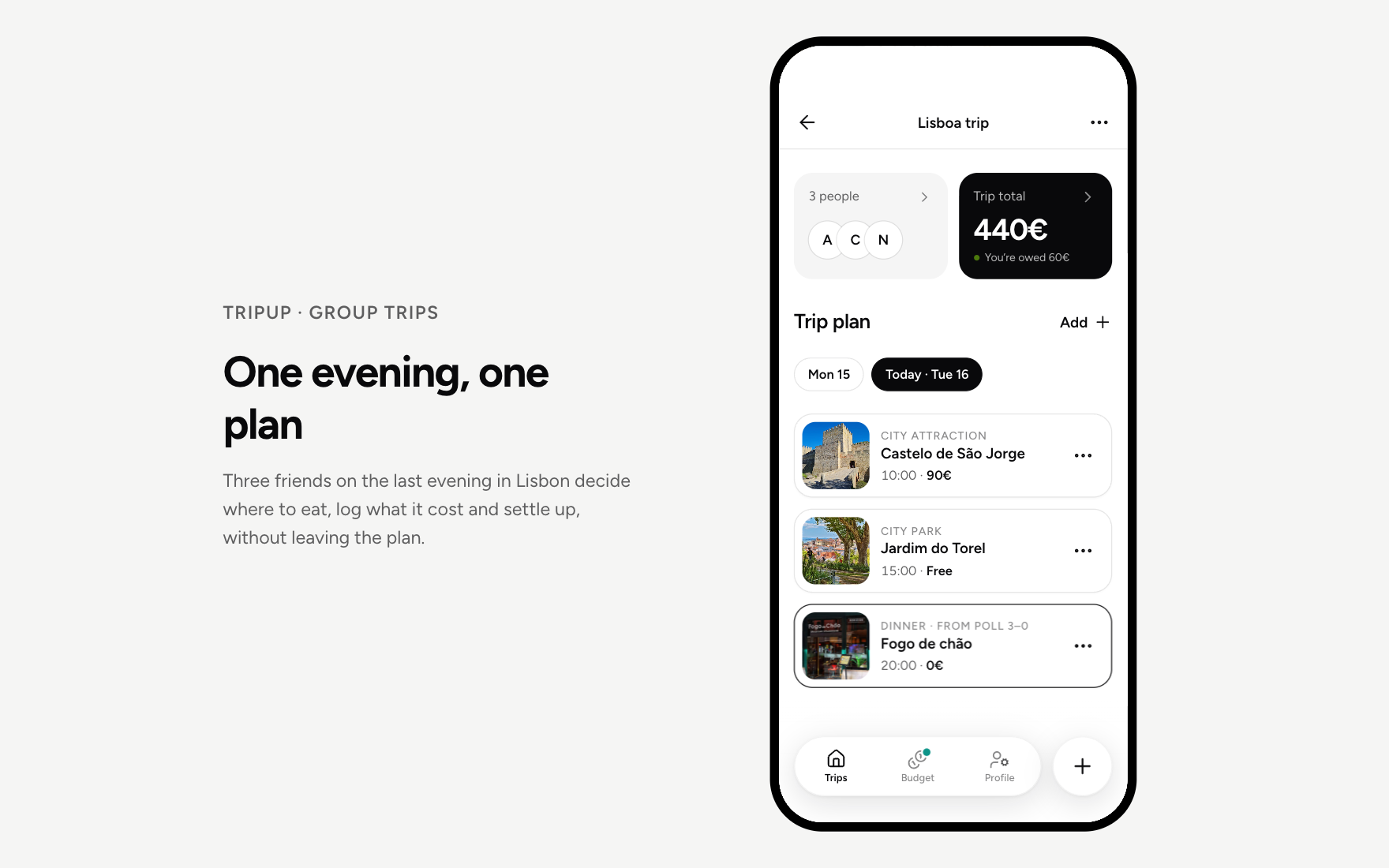
One plan for where the group eats and who pays
Group trips stall twice: deciding together and settling money. I designed one evening of a trip app where a poll result becomes the plan, and the bill attaches to it. Built as a working mobile prototype.
Read the caseI am most useful before the interface is obvious: when the data model is unfinished, ownership is split between teams, and somebody has to make a decision the rest can build on.
In practice that means reading the data model before I open a design file, writing each tradeoff down before it ships, and going back after release to check which assumptions held. The screens come last.
The path
- 2024 to nowadjoeRewarded ads platform, two dashboards and the design system
- 2022 to 2024InsiderMartech, led the Mobile Suite team
- 2021 to 2022GetirConsumer super app, launched car rental
- 2018 to 2021Koç UniversityBranding and interface work for startups and NGOs
Consumer speed first, then marketing tooling, then platform infrastructure. Each move took me closer to where a wrong decision has a measurable cost.
What the people I worked with say.
Before Erdem joined my team, I had issues working with designers: messy Figma files, missed states, and a communication gap between teams. Erdem was a brilliant designer, and a friend, who did not just push designs to development but gathered everyone's input to mature the solution together. During handoff, every question we had was either resolved or got real attention from him. He turned our design to release cycle from a challenge into something to enjoy.
 MEMansur Muaz EkiciSenior Frontend Engineer, Insider
Erdem is that magnetic force that keeps cross functional teams with very different backgrounds engaged and together. He creates a space where laughter meets rigour. He has a unique approach: he executes meticulous design work and then delivers it with a good portion of dad jokes. As we worked together, he inspired me in my own leadership journey. It was a blast to work with him.
 DÖDuygu ÖzgülDesign Lead, Insider
In a fast paced company with a lot of tech debt, Erdem always found a workaround. Sometimes an alternative design, sometimes more detail on how our product is structured. What he does best is provide solutions rather than become a bottleneck when times are hard. I really enjoy his approach as a proactive problem solver.
 PPuruSenior Frontend Engineer, adjoe
Getir has a speed culture, and design has to respond to every requirement at once: C-level requests, legal pushes, fast growing market demands. Under all that pressure, Erdem was one of the solution makers in my team. I relied on him for multiple projects and crises, trusting him to take a brief from me and finalise it end to end.
 UYUmut Can YurtalanHead of Design, Getir
If the problem is genuinely complicated, I am interested.
Open to senior and lead roles in B2B and platform teams. Happy to talk through any of the work above in detail.